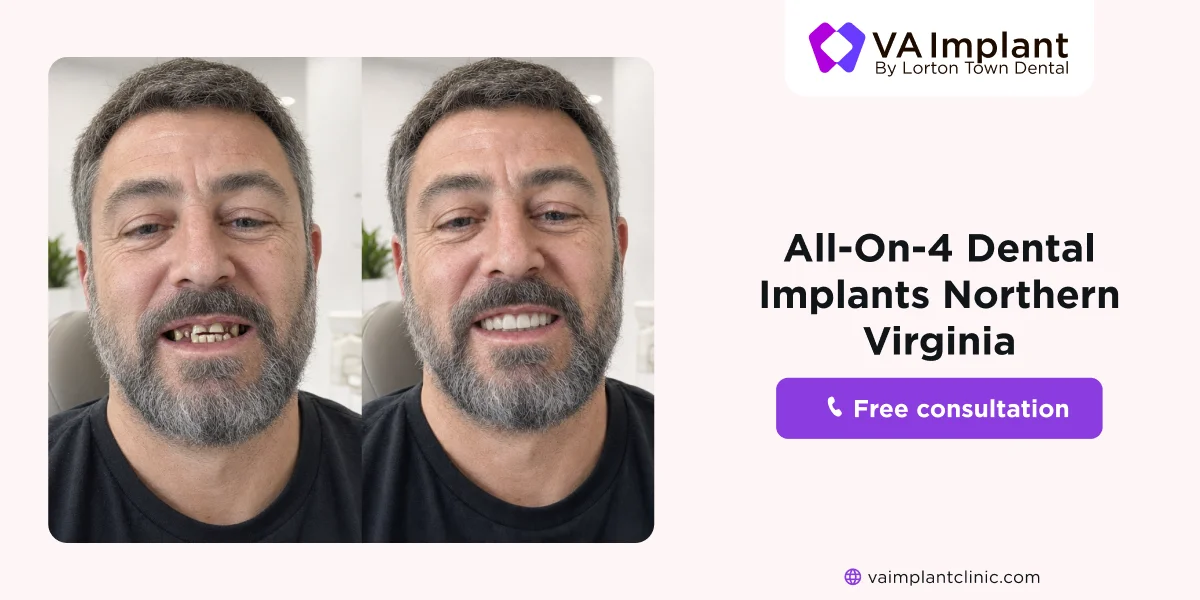
Quick answer: All on 4 dental implants in Northern Virginia give you a complete arch of fixed teeth anchored to four titanium posts, placed in one surgical visit. You’re typically looking at $20,000 to $30,000 per arch depending on bone condition, materials, and prep work. Most patients leave the same day with a temporary set of teeth and return months later for the permanent version.
Why All on 4 Dental Implants in Northern Virginia Attract so Many Patients
A patient sat in our Lorton-area office last spring, gripping the armrests with white knuckles. She’d worn a loose upper denture for nine years. Eating corn on the cob at a Fairfax County cookout was out of the question. She wanted something anchored. Something that felt like real teeth.
That is exactly what all on 4 dental implants in Northern Virginia are built to do. Four titanium posts go into your jawbone at precise angles. A full arch of prosthetic teeth locks onto those posts. You walk out with teeth that stay put.
A dental implant is a small titanium screw that fuses with your jawbone over several months, acting as an artificial tooth root. The “all on 4” concept uses only four of these implants to support an entire upper or lower arch, which is fewer posts than older methods required.
The reason this approach matters in the Northern Virginia suburbs, from Lorton to Woodbridge to Springfield, is practical. Many patients here have put off treatment for years because they assumed they’d need eight or ten individual implants, bone grafts, and a year of waiting. All on 4 dental implants in Northern Virginia changed that math. Four posts. One surgery. A set of teeth the same day.
But fewer posts does raise fair questions. Can four implants really hold a full arch? How long will they last? And what does this actually cost in NoVa? Those are the questions this guide answers, section by section.
How All on 4 Dental Implants in Northern Virginia Work Step by Step
You’ll go through a clear sequence. Knowing what happens at each stage helps the whole process feel smaller.
- Consultation and 3D imaging. Your dentist takes a cone-beam CT scan to map your jawbone in three dimensions. This scan shows bone density, nerve position, and sinus location. It is the blueprint for everything that follows.
- Treatment planning. Using that scan, the team plans where to place all four implants. The two back posts go in at an angle, usually around 30 to 45 degrees, so they grab denser bone near the front of the jaw and avoid the sinus cavity above or the nerve canal below.
- Surgery day. You’re sedated. Any remaining teeth are removed. The four titanium posts go in. A temporary acrylic arch is attached before you leave, so you walk out with a full set of teeth that same afternoon.
- Healing period. Over the next three to six months the implants fuse with your bone through a process called osseointegration. You eat soft foods during the first few weeks and gradually work back to firmer textures.
- Final prosthesis. Once the bone has locked around the posts, your dentist removes the temporary arch and attaches your permanent teeth, typically made of zirconia or acrylic over a metal frame.
The angled placement of the rear posts is the mechanical reason all on 4 dental implants in Northern Virginia work with less bone than traditional methods. Tilting the post lets it contact a longer stretch of jawbone, which spreads the chewing force across a wider area. For patients who’ve been told they lack enough bone for standard implants, that angle can sometimes eliminate the need for a separate bone grafting procedure.
Not everyone qualifies without grafting, though. Your 3D scan will tell the story. If you do need bone work, the team at our clinic discusses that before any commitment.
What Drives the All on 4 Cost in Northern Virginia
You’re probably looking at $20,000 to $30,000 per arch. What moves that number? Three main things.
Your bone. If the scan shows adequate density in the right spots, the surgeon places posts directly. If it doesn’t, you may need grafting or even zygomatic implants that anchor into the cheekbone instead. Either option adds cost and time.
The final teeth you pick. A zirconia arch is harder, more stain-resistant, and pricier than acrylic over a metal bar. Both work. Zirconia tends to last longer and looks closer to natural enamel. Your dentist will show you samples so you can compare them side by side.
Prep work. Extractions, infection treatment, and any temporary appliances before surgery day all factor in. Some patients need very little prep. Others need significant work first.
All on 4 Cost in Northern Virginia Compared to Other Options
| Option | Typical cost per arch | Time to final teeth | Bone graft usually needed? | Best for |
|---|---|---|---|---|
| All on 4 implants | $20,000 to $30,000 | 3 to 6 months | Often no | Patients with moderate bone who want fixed teeth fast |
| Traditional implant bridge (6 to 8 posts) | $25,000 to $45,000 | 6 to 12 months | Often yes | Patients with strong bone throughout the arch |
| Implant-supported denture (snap-on) | $12,000 to $20,000 | 3 to 6 months | Sometimes | Patients who want removable but stable teeth at a lower price |
| Traditional full denture | $1,500 to $4,000 | Weeks | No | Patients on a tight budget who accept a removable appliance |
Many dental insurance plans cover a portion of the implant cost, and some offices, including ours, offer financing that breaks the total into monthly payments. Ask about this during your consultation because the sticker price alone does not tell the full story of what you’ll pay out of pocket.
Understanding cost helps, but what about the days right after surgery? That’s often the part patients worry about most.
Recovery After Full Arch Implants in Lorton and the NoVa Suburbs
The first 48 hours are the hardest. Swelling peaks around day two or three. You’ll ice your face in 20-minute rounds and stick to cool, soft foods: yogurt, smoothies, scrambled eggs, mashed potatoes. Most patients manage discomfort with prescription pain medication for the first few days and then switch to over-the-counter ibuprofen.
By the end of week one, the swelling drops noticeably. Most people return to desk work within three to five days. If your job is physical, plan on seven to ten days off.
Weeks two through six are about patience. Your temporary arch is functional but not indestructible. Avoid biting into hard bread, raw carrots, or anything that could crack acrylic. We had a patient last fall who tried beef jerky at day 12. It did not go well. He was fine, but the temporary needed a quick repair in our office.
At around three to six months, your dentist checks the implants with imaging to confirm osseointegration is complete. Once the bone has fused solidly around all four posts, you come in for the final prosthesis fitting. That appointment usually takes a couple of hours. You leave with your permanent teeth.
According to the American Academy of Implant Dentistry, dental implants that integrate properly can function for decades with appropriate care. Results depend on your oral hygiene, follow-up visits, and overall health.
So what does proper care actually look like once you have your final teeth?
How to Protect All on 4 Dental Implants in Northern Virginia Long Term
You brush twice a day, just like natural teeth. A soft-bristle electric toothbrush works well. You also clean under the arch using a water flosser or specialized floss threaders, because food particles collect between the prosthesis and your gumline.
Professional cleanings matter, too. Plan on visiting your dentist every six months. During these visits the hygienist removes the arch, cleans around the abutments, and checks for early signs of gum irritation or bone changes. Catching a small issue early is much simpler than managing a larger one later.
Smoking is the single biggest risk factor after surgery. Nicotine restricts blood flow to the gums and bone, which slows healing and raises the chance of implant failure. If you smoke, your dentist will talk honestly with you about that risk and may recommend a cessation plan before scheduling surgery. Patients choosing all on 4 dental implants in Northern Virginia who quit smoking before the procedure give their implants a measurably better chance of lasting.
Signs Something Needs Attention
Watch for persistent swelling that doesn’t improve after the first week, a loose feeling in the arch, or gums that bleed when you brush. Any of these warrants a call to the office. Early intervention keeps small problems small. If you notice something off with your all on 4 dental implants in Northern Virginia, don’t wait for your next scheduled cleaning. Reach out right away.
For a deeper look at warning signs, our post on all-on-4 problems you shouldn’t ignore covers each one in detail.
What All on 4 Dental Implants in Northern Virginia Mean for Your Next Step
You’ve read the procedure, the costs, the recovery, and the long-term care. The question left is whether this is the right fit for your mouth, your budget, and your life in the NoVa suburbs.
That answer starts with a single consultation. The lead dentist and the team at VA Implant Clinic will take a 3D scan, examine your bone, review your medical history, and tell you clearly whether all on 4 dental implants in Northern Virginia are the right path or whether a different approach, like an implant denture or a full mouth implant plan, makes more sense.
There is no pressure in that room. Only information. If you’re ready to find out where you stand, Schedule Free Consultation or call VA Implant Clinic directly. The team answers questions every day, and yours are welcome.
FAQs
How Long Do All on 4 Dental Implants in Northern Virginia Last?
With proper care, the titanium posts can last decades. The prosthetic arch typically lasts 10 to 20 years before it may need replacement or refurbishment, depending on material and wear.
Can I Get All on 4 Dental Implants If I Have Bone Loss?
Often yes. The angled rear posts grab denser bone that traditional vertical implants can’t reach. Your 3D scan will confirm whether you qualify or need supplemental grafting first.
Does Insurance Cover All on 4 Cost in Northern Virginia?
Some dental plans cover a portion, usually the extraction and prosthetic components. Coverage varies widely, so bring your benefits summary to your consultation and the billing team will break down your estimated out-of-pocket cost.
How Soon Can I Eat Normal Food After All on 4 Dental Implants in Northern Virginia?
Soft foods only for the first six to eight weeks. Once the permanent arch is placed at three to six months, you can return to most foods including steak, apples, and crusty bread.
Is the Surgery Painful?
You’re sedated during the procedure and won’t feel the surgery itself. Post-operative soreness peaks around day two or three and is manageable with prescribed and over-the-counter pain medication for most patients.
What Happens If One of the Four Implants Fails?
Your dentist monitors integration at every follow-up. If a post doesn’t fuse properly, it can often be replaced with a slightly larger implant in the same visit. Our guide to implant failure causes explains the most common reasons and how to prevent them.